“GROOVE – Experienced Synchronization for Connectedness and Closeness in Social Virtual Reality”. The project is funded for three years by the Federal Ministry of Research, Technology and Space (BMFTR) with over 1.5 million euros.
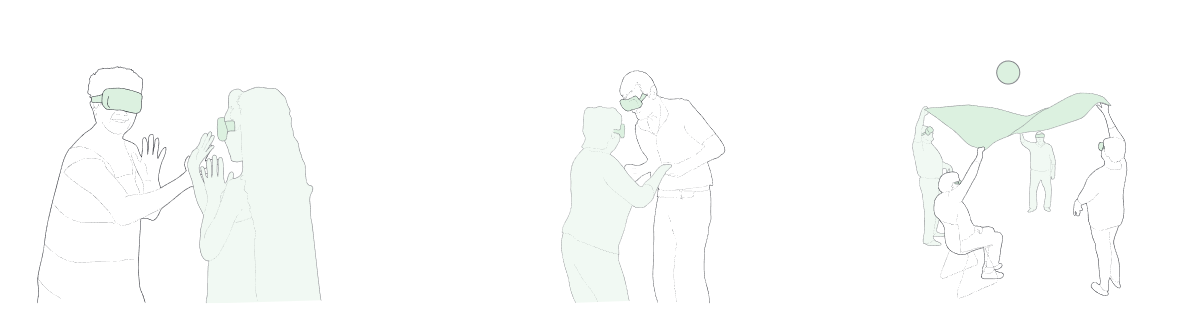
The GROOVE project aims to induce social entrainment in virtual environments to sustainably strengthen feelings of personal connectedness. Often groups of friends live all over the country, couples are in long-distance relationships, or grandparents live far away from their grandchildren. How can you still spend time together with more proximity than in a video conference? More and more people are using social virtual reality for this purpose: They meet in virtual worlds and do something together there, such as singing, dancing or playing exercise games.
Social virtual reality enables people to experience such interpersonal interaction together even across distances. However, current VR applications do not support precise temporal synchronization. Activities of the respective other person are not experienced simultaneously and the interaction parties literally get out of sync.
Three departments of the Bauhaus University Weimar are also involved in the project. They are coordinated by Prof. Dr. Eva Hornecker and her HCI working group, which has extensive research expertise in Tangible and Embodied Interaction. The group is responsible, in particular, for the project’s coordination and the project’s human-centered design process.
Furthermore, Prof. Dr. Bernd Fröhlich, Chair of Virtual Reality Systems, and his Virtual Reality and Visualization Research group conduct research and development in the areas of collaborative virtual reality, 3D user interfaces, and the like. In this project, the group is mainly involved in developing and implementing interactive social VR systems.